
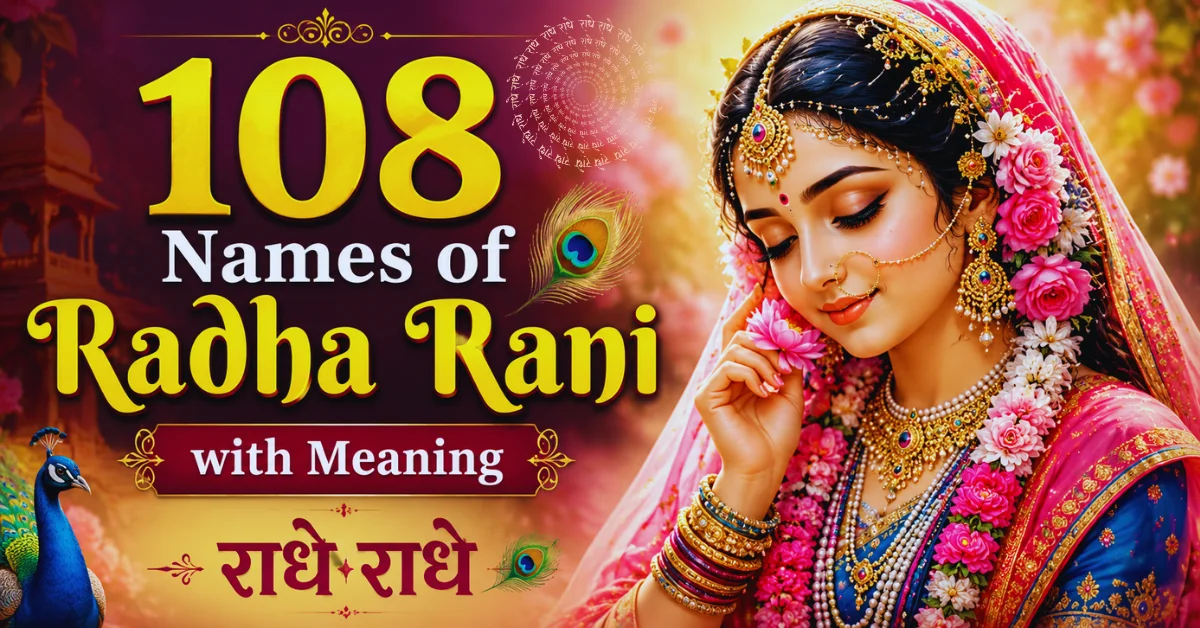
108 Names of Radha Rani, lovingly known as Shri Radha, is revered in the Vaishnava tradition as the embodiment of divine love, compassion, devotion, and spiritual bliss. Her name is inseparably connected with Shri Krishna, and devotees believe that remembering Radha’s name with a sincere heart brings peace, devotion, and a deeper connection with divine love.
The 108 names of Radha Rani offer a beautiful way to contemplate her many divine qualities. Each name expresses a particular aspect of Shri Radha’s personality, spiritual glory, relationship with Krishna, or compassionate nature.
Chanting these names is not simply a ritual of repeating words. For many devotees, it is a form of meditation in which the mind gradually turns away from worldly distractions and becomes absorbed in Radha-Krishna bhakti.
“राधे राधे जपो चले आएंगे बिहारी।”
The loving remembrance of Radha is traditionally cherished as a simple and powerful expression of devotion to the Divine Couple.
108 Names of Radha Rani in English
Below, we have provided a devotional list of the 108 names of Radha Rani, along with their simple English meanings. While spellings and the sequence of names may vary across different Vaishnava traditions and scriptures, this compilation is presented in a format that is both easy to understand and imbued with devotion.
| No. | 108 Names of Radha Rani | Meaning |
| 1 | Shri Radha | The embodiment of divine love and devotion |
| 2 | Radhika | She who worships Krishna with supreme devotion |
| 3 | Radharani | The revered Queen of Vrindavan |
| 4 | Vrishabhanu-Nandini | Daughter of King Vrishabhanu |
| 5 | Kirti-Nandini | Beloved daughter of Mother Kirti |
| 6 | Vrindavaneshwari | Queen of Vrindavan |
| 7 | Krishna-Priya | Beloved of Lord Krishna |
| 8 | Krishna-Kanta | The beloved consort of Krishna |
| 9 | Krishna-Vallabha | Dearly loved by Krishna |
| 10 | Madhava-Priya | Beloved of Madhava, Shri Krishna |
| 11 | Govinda-Priya | Dear to Govinda |
| 12 | Gopinath-Priya | Beloved of Gopinath |
| 13 | Gokuleshwari | Divine queen associated with Gokula |
| 14 | Brajeshwari | Queen of the sacred land of Braj |
| 15 | Brajapriya | Beloved of the people of Braj |
| 16 | Brajangana | The most celebrated among the women of Braj |
| 17 | Brajabala | The divine maiden of Braj |
| 18 | Vrindavani | She who is intimately connected with Vrindavan |
| 19 | Vrinda | Associated with the sacred Vrindavan grove |
| 20 | Vanadevi | Goddess-like mistress of the forest groves |
| 21 | Nikunjeshwari | Queen of the secluded divine groves |
| 22 | Kunjeshwari | Mistress of the sacred kunjas |
| 23 | Lalita-Sakhi-Priya | Beloved companion of Lalita Sakhi |
| 24 | Vishakha-Priya | Dear companion of Vishakha Sakhi |
| 25 | Sakhi-Shiromani | Crown jewel among the divine companions |
| 26 | Gopi-Shiromani | Supreme jewel among the Gopis |
| 27 | Gopi-Priya | Beloved of the Gopis |
| 28 | Gopika | The divine cowherd maiden |
| 29 | Gopi-Vallabha | Beloved among the Gopis |
| 30 | Premamayi | Filled completely with divine love |
| 31 | Premarupa | Whose very form is divine love |
| 32 | Prema-Shakti | Embodiment of the power of divine love |
| 33 | Premeshwari | Goddess of divine love |
| 34 | Karunamayi | Filled with compassion |
| 35 | Kripamayi | Full of divine grace and mercy |
| 36 | Dayamayi | Embodiment of kindness |
| 37 | Daya-Sindhu | Ocean of compassion |
| 38 | Kripa-Sindhu | Ocean of divine mercy |
| 39 | Bhakti-Prada | Bestower of devotion |
| 40 | Bhakti-Dayini | She who grants loving devotion |
| 41 | Bhakta-Vatsala | Affectionate toward her devotees |
| 42 | Bhakta-Priya | Dear to sincere devotees |
| 43 | Bhakta-Palana-Kari | Protector of her devotees |
| 44 | Sharanagata-Vatsala | Compassionate toward those who surrender to her |
| 45 | Abhaya-Pradayini | Giver of freedom from fear |
| 46 | Mangalada | Bestower of auspiciousness |
| 47 | Mangalamayi | Filled with divine auspiciousness |
| 48 | Anandamayi | Embodiment of spiritual bliss |
| 49 | Ananda-Rupini | Whose nature is supreme joy |
| 50 | Hladini-Shakti | Embodiment of Krishna’s spiritual bliss potency |
| 51 | Madhurya-Rupini | Embodiment of divine sweetness |
| 52 | Madhura | The supremely sweet one |
| 53 | Madhavi | She who embodies divine sweetness and springlike beauty |
| 54 | Shyama-Priya | Beloved of Shyama |
| 55 | Shyama-Sundari | The beautiful beloved of Shyama |
| 56 | Mohan-Priya | Beloved of the enchanting Krishna |
| 57 | Madan-Mohini | She who enchants even the greatest enchanter |
| 58 | Krishna-Mohini | She who captivates Krishna through divine love |
| 59 | Govinda-Mohini | She whose love enchants Govinda |
| 60 | Muralimanohari | She who delights in Krishna’s enchanting flute |
| 61 | Venunada-Priya | Fond of the melody of Krishna’s flute |
| 62 | Rasa-Priya | Beloved of the divine rasa |
| 63 | Rasa-Rani | Queen of divine loving rasa |
| 64 | Rasa-Vilasini | She who delights in divine loving pastimes |
| 65 | Rasa-Swaroopini | Embodiment of divine spiritual rasa |
| 66 | Rasika | One who fully appreciates divine love |
| 67 | Rasikeshwari | Queen of divine spiritual rasa |
| 68 | Rasapriya | Lover of transcendental devotional bliss |
| 69 | Mahabhava-Swaroopini | Embodiment of the highest divine love |
| 70 | Prema-Sindhu | Ocean of divine love |
| 71 | Prema-Swarupini | Personification of pure love |
| 72 | Krishna-Anuragini | Deeply devoted and attached to Krishna |
| 73 | Krishna-Mayee | Completely absorbed in Krishna |
| 74 | Krishna-Chitta | Whose consciousness is centered upon Krishna |
| 75 | Krishna-Sarvasva | For whom Krishna is everything |
| 76 | Krishna-Jivani | Whose life is centered upon Krishna |
| 77 | Madhava-Sangini | Eternal companion of Madhava |
| 78 | Madhava-Manohari | She who enchants Madhava |
| 79 | Damodara-Priya | Beloved of Damodara |
| 80 | Gopinatheshwari | Divine queen beloved of Gopinath |
| 81 | Govardhaneshwari | Revered as the divine queen associated with Govardhan |
| 82 | Yamuna-Priya | Beloved of the sacred Yamuna |
| 83 | Yamuna-Tata-Viharini | She who delights in the divine pastimes along the Yamuna |
| 84 | Kusuma-Priya | Fond of flowers |
| 85 | Kusumavati | Beautiful like a flowering garden |
| 86 | Malati-Priya | Fond of fragrant Malati flowers |
| 87 | Kadamba-Priya | Fond of the sacred Kadamba groves |
| 88 | Vrindavan-Viharini | She who delights in the groves of Vrindavan |
| 89 | Nikunjaviharini | She who enjoys divine pastimes in the kunjas |
| 90 | Kunja-Priya | Beloved of the sacred forest groves |
| 91 | Chandravali | Radiant and graceful like moonlight |
| 92 | Chandramukhi | She whose face is beautiful like the moon |
| 93 | Chandrakanti | Possessing moonlike radiance |
| 94 | Padmavati | Beautiful like a lotus |
| 95 | Padmamukhi | Lotus-faced goddess |
| 96 | Kamala | Lotus-like and supremely beautiful |
| 97 | Komalangi | She whose limbs are delicately beautiful |
| 98 | Charuhasini | She who possesses a beautiful smile |
| 99 | Manohara | Supremely captivating and beautiful |
| 100 | Sundari | The beautiful divine maiden |
| 101 | Shubhangi | She whose form is wonderfully auspicious |
| 102 | Saubhagyavati | Embodiment of divine fortune and auspiciousness |
| 103 | Sarva-Mangala | Source of all auspiciousness |
| 104 | Sarveshwari | Supreme divine mistress |
| 105 | Jagad-Mata | Divine mother of the world |
| 106 | Jagad-Janani | Mother of all beings |
| 107 | Radha-Krishna-Priya-Shakti | The beloved divine energy of Radha-Krishna |
| 108 | Shri Raseshwari | The supreme queen of divine rasa |

Why Are There 108 Names of Radha Rani?
The number 108 has a special place in Hindu spiritual traditions. It appears throughout devotional practices, including the use of 108-bead japa malas and the recitation of sacred names.
When a devotee chants 108 names, the practice provides a structured period of remembrance. Instead of allowing the mind to wander, each name becomes an opportunity to contemplate a particular divine quality.
For Radha bhakti, the number 108 can therefore be understood as a devotional framework for remembering the many dimensions of Shri Radha’s divine personality.
The purpose is not merely to complete a number. The deeper purpose is to develop shraddha (faith), prema (divine love), smarana (remembrance), and bhakti (devotion).
The Spiritual Significance of 108 Names of Radha Rani
1. Radha – The Essence of Divine Love
The name Radha is deeply revered by devotees of Krishna. In Gaudiya Vaishnava philosophy, Shri Radha represents the highest expression of loving devotion toward Krishna.
Her love is described not as ordinary worldly affection but as completely selfless divine prema.
Remembering Radha therefore reminds the devotee that genuine devotion is not based on personal gain. It is about loving the Divine wholeheartedly.
2. Radhika – The Supreme Devotee
The name Radhika is especially beloved in the Braj devotional tradition.
It expresses the idea of one who is completely dedicated to Krishna. Her devotion is often regarded as the highest example of loving surrender.
For a devotee, remembering Radhika can become an inspiration to develop humility, faith, and sincere devotion.
3. Vrishabhanu-Nandini – Daughter of Vrishabhanu
Radha Rani is traditionally described as the daughter of Vrishabhanu Maharaj and Mother Kirti.
The name Vrishabhanu-Nandini literally points toward her beloved relationship with her father, Vrishabhanu.
This name brings devotees into the intimate atmosphere of Braj, where Radha is remembered not only as a supreme divine personality but also through the affectionate relationships of her childhood.
4. Vrindavaneshwari – Queen of Vrindavan
Vrindavan is central to Radha-Krishna devotion.
The name Vrindavaneshwari means the queen or divine mistress of Vrindavan.
When devotees chant this name, they remember the sacred groves, Yamuna banks, temples, forests, peacocks, flowers, and devotional atmosphere associated with Radha and Krishna.
5. Krishna-Priya – Beloved of Krishna
Among Radha’s many names, Krishna-Priya expresses one of the most important themes of Radha-Krishna bhakti.
Radha is the beloved of Krishna, and Krishna is the beloved of Radha.
Their relationship represents the highest spiritual expression of divine love in many Vaishnava traditions.
6. Premamayi – Full of Divine Love
Premamayi means “she who is filled with love.”
Radha is frequently contemplated as the personification of pure prema.
This name can be especially meaningful during meditation because it encourages devotees to move beyond mechanical worship and cultivate a loving relationship with the Divine.
7. Karunamayi – Full of Compassion
The name Karunamayi means compassionate or filled with mercy.
Devotees often approach Radha Rani with the feeling of a child approaching a loving mother.
The name reminds us that devotion can also be a place of emotional refuge, hope, and surrender.
8. Kripamayi – Embodiment of Grace
Kripamayi describes one who is full of divine grace.
In devotional practice, grace is considered essential because spiritual progress is not viewed simply as the result of human effort.
A devotee may therefore chant this name while praying for guidance, humility, and the strength to remain devoted.
9. Bhakti-Prada – Bestower of Devotion
The name Bhakti-Prada means “she who gives devotion.”
This is particularly significant because bhakti itself is regarded as a divine gift.
A person may have knowledge, wealth, success, or worldly achievements, yet still feel spiritually empty. The devotee therefore prays for the gift of genuine devotion.
10. Hladini-Shakti – Divine Bliss Potency
In Gaudiya Vaishnava theology, Hladini Shakti refers to the divine potency associated with spiritual bliss.
Shri Radha is traditionally understood as the supreme manifestation of this loving, bliss-giving potency. This makes the name particularly important for those studying the theological dimensions of Radha-Krishna philosophy.
Radha Rani and the Sacred Land of Braj
To understand Radha’s names more deeply, it is helpful to understand Braj.
Braj is traditionally associated with the divine pastimes of Shri Krishna. Places such as Vrindavan, Barsana, Nandgaon, Gokul, Govardhan, and the banks of the Yamuna occupy a special position in Krishna bhakti.
Among these sacred places, Barsana is especially associated with Radha Rani.
Devotees visit Radha’s temples, walk through the narrow lanes of Braj, participate in kirtan, and lovingly repeat:
“Radhe Radhe!”
In Braj culture, this simple expression has become much more than a greeting. It is a devotional remembrance of Shri Radha.

How to Chant the 108 Names of Radha Rani
You do not need an elaborate ritual to begin chanting Radha Rani’s names.
A simple devotional practice can be followed.
Step 1: Choose a Peaceful Place
Sit somewhere clean and quiet. A temple, home altar, meditation room, or peaceful corner can work well.
Step 2: Remember Radha Krishna
Before beginning, close your eyes and mentally remember Shri Radha and Shri Krishna.
You may visualize the divine couple in the beautiful groves of Vrindavan.
Step 3: Chant Each Name Slowly
Read each name carefully rather than rushing through the list.
For example:
Shri Radha – The embodiment of divine love.
Radhika – The supreme devotee of Krishna.
Vrindavaneshwari – Queen of Vrindavan.
Krishna-Priya – Beloved of Krishna.
Karunamayi – Full of compassion.
Step 4: Understand the Meaning
The meaning of each name can become the focus of meditation.
Instead of merely saying “Karunamayi,” think about divine compassion.
Instead of merely saying “Premamayi,” contemplate selfless divine love.
Step 5: End With a Simple Prayer
After completing the 108 Names of Radha Rani, you may pray:
“हे राधा रानी, मेरे मन में प्रेम, भक्ति, विनम्रता और श्री कृष्ण के प्रति सच्ची श्रद्धा प्रदान करें।”
Benefits of Chanting 108 Names of Radha Rani
Devotees traditionally associate the remembrance of Radha’s names with several spiritual and emotional benefits.
1. Encourages Devotion
Regular remembrance can help cultivate a devotional mindset and strengthen one’s connection with Radha-Krishna bhakti.
2. Brings Mental Peace
Repetition of sacred names can give the mind a single point of concentration, helping create a peaceful devotional atmosphere.
3. Develops Humility
Radha bhakti places great importance on humility and selfless love. Remembering her qualities can inspire devotees to cultivate these virtues in everyday life.
4. Strengthens Faith
Regular spiritual remembrance can help devotees maintain faith during difficult periods of life.
5. Creates a Positive Spiritual Environment
Chanting sacred names at home can become a meaningful part of daily prayer, meditation, or family worship.
6. Deepens Radha-Krishna Remembrance
Because Radha’s names are closely connected with Krishna, chanting them naturally turns the devotee’s attention toward the Divine Couple.
Best Time to 108 Names of Radha Rani
There is no single time that every devotee must follow. The most important element is sincerity and regularity.
However, many devotees prefer spiritual practice during:
- Early morning
- Brahma Muhurta
- After taking a bath
- During evening prayer
- Before going to sleep
- During Radha-Krishna kirtan
- On special Vaishnava festivals
Early morning can be particularly peaceful because the environment is generally quieter and the mind may be less occupied with the day’s activities.
Can We Chant 108 Names of Radha Rani Without a Guru?
Different Vaishnava traditions have different approaches to mantra initiation and formal spiritual practice.
For simple devotional remembrance, reading sacred names, praying to Radha Rani, and cultivating devotion can be practiced sincerely by devotees.
However, formal diksha mantras and advanced devotional practices should be learned according to the tradition and guidance of a qualified spiritual teacher.
The important distinction is between general devotional remembrance and formally initiated spiritual practices.
108 Names of Radha Rani as a Daily Meditation
One beautiful way to use these 108 names is to select one name each day and reflect upon its meaning.
For example:
Monday – Karunamayi
Meditate on compassion.
Tuesday – Premamayi
Reflect on selfless love.
Wednesday – Bhakti-Prada
Pray for sincere devotion.
Thursday – Kripamayi
Remember divine grace.
Friday – Vrindavaneshwari
Meditate upon the sacredness of Vrindavan.
Saturday – Krishna-Priya
Remember the loving relationship between Radha and Krishna.
Sunday – Anandamayi
Contemplate spiritual joy and inner peace.
In this way, the names become more than a list. They become points of daily spiritual reflection.
108 Names of Radha Rani for Bhajan and Kirtan
The 108 Names of Radha Rani are also naturally suited to devotional singing.
A simple kirtan can repeat:
Radhe Radhe Radhe Radhe
Radhika Radhika Radhe
Vrindavaneshwari Radhe
Krishna-Priya Radhe
Such repetition can create a meditative atmosphere in which the mind gradually becomes absorbed in devotional remembrance.
For a music creator or bhajan singer, the 108 names can also inspire a complete Radha Ashtottara Shatanamavali bhajan, with each section highlighting different qualities of Shri Radha.
The Deeper Message Behind 108 Names of Radha Rani
The most beautiful aspect of these names is that they present devotion from many different perspectives.
Radha is remembered as:
- A daughter – Vrishabhanu-Nandini
- A queen – Vrindavaneshwari
- A beloved – Krishna-Priya
- An embodiment of love – Premamayi
- A source of compassion – Karunamayi
- A giver of grace – Kripamayi
- A bestower of devotion – Bhakti-Prada
- The queen of divine rasa – Raseshwari
- A symbol of spiritual bliss – Anandamayi
- The embodiment of divine love – Prema-Swarupini
Together, these names create a devotional portrait of Shri Radha. They remind us that spirituality is not only about knowledge or ritual. It is also about love, compassion, surrender, humility, remembrance, and service.
108 Names of Radha Rani and the Path of Prema Bhakti
The word prema means profound divine love.
In Radha-Krishna devotion, prema is considered the highest expression of bhakti. It is not based on fear or expectation of material rewards.
The devotee does not approach the Divine merely by saying:
“Give me success.”
Instead, the heart gradually learns to pray:
“Give me devotion.”
This is one of the central spiritual ideas represented by Radha.
Her devotion toward Krishna is therefore remembered as an ideal of complete loving dedication.
A Simple Radha Rani Prayer
After chanting the 108 Names of Radha Rani, devotees may conclude with a simple prayer:
हे श्री राधे,
मेरे हृदय को अपने प्रेम से भर दीजिए।
मेरे मन से अहंकार और नकारात्मकता को दूर कीजिए।
मुझे सच्ची भक्ति, विनम्रता और करुणा प्रदान कीजिए।
मेरे जीवन में श्री कृष्ण के नाम का स्मरण बना रहे।
राधे राधे।
The prayer does not need complicated Sanskrit. A sincere heart is the most important offering.
Frequently Asked Questions About the 108 Names of Radha Rani
Q1. What are the 108 names of Radha Rani?
The 108 Names of Radha Rani are devotional names and descriptions used to remember different qualities, relationships, forms, and divine attributes associated with Shri Radha.
Q2. What is Radha Rani also called?
Some widely loved names include Radha, Radhika, Radharani, Vrishabhanu-Nandini, Vrindavaneshwari, Krishna-Priya, Krishna-Vallabha, Premamayi, Karunamayi, Kripamayi, and Raseshwari.
Q3. Why is Radha called Radhika?
Radhika is an affectionate and devotional form of the name Radha. In Vaishnava traditions, the name is closely associated with her supreme devotion and loving service to Krishna.
Q4. Who is Radha Rani?
In the devotional traditions of Vaishnavism, Shri Radha is revered as Krishna’s eternal beloved and as the supreme embodiment of divine love and devotion. Different Vaishnava traditions describe her theological position in somewhat different ways.
Q.5 What does Radha mean?
The Sanskrit name Radha is traditionally connected with meanings such as worship, devotion, and the one who gives pleasure or satisfaction in a devotional context. Interpretations can vary according to linguistic and theological tradition.
Q6. Can I chant the 108 Names of Radha Rani every day?
Yes. Many devotees choose to include sacred-name remembrance in their daily prayer or meditation practice.
Q7. How many times should Radha’s names be chanted?
There is no universal number required for simple devotional remembrance. You may chant the names once, use a mala, or repeat individual names according to your devotional practice.
Q8. What is the best mantra for Radha Rani?
Devotees use different Radha and Radha-Krishna mantras according to their spiritual tradition. A simple and widely loved devotional remembrance is: “Radhe Radhe.”
Q9. Is Radha Rani worshipped separately from Krishna?
Yes. In many devotional traditions, Radha is worshipped independently while also being worshipped together with Krishna as Radha-Krishna. The exact theological understanding varies among traditions.
Conclusion,
The 108 Names of Radha Rani are much more than a collection of beautiful names. Each name offers a doorway into a different aspect of divine love.
When we remember Vrishabhanu-Nandini, we remember the beloved daughter of Braj.
When we chant Vrindavaneshwari, we remember the divine queen of Vrindavan.
When we repeat Krishna-Priya, we remember the eternal loving connection between Radha and Krishna.
When we chant Karunamayi and Kripamayi, we remember divine compassion and grace.
And when we remember Premamayi, we turn our hearts toward the highest ideal of selfless spiritual love.
Whether these names are chanted during morning prayer, temple worship, bhajan, kirtan, meditation, or simply repeated quietly throughout the day, their deeper purpose is remembrance.
The ultimate message of Radha bhakti is beautifully simple:
Let the heart become filled with love, let the mind remember the Divine, and let life become an offering of devotion.
If you liked this article about the 108 Names of Radha Rani Please stay connected with our blog for more insightful articles on festivals, temples, history, and India’s spiritual heritage. Keep following Mero Bradham for more insightful and well-researched articles about the best places to visit in Nandgaon and Barsana.
राधे राधे!
जय श्री राधे!
जय श्री राधा–कृष्ण!
108 names of Radha Rani PDF
Radha Rani 108 Naam pdf, Below, we have provided a devotional list of the 108 names of Shri Radha Rani pdf.

